
Abstract
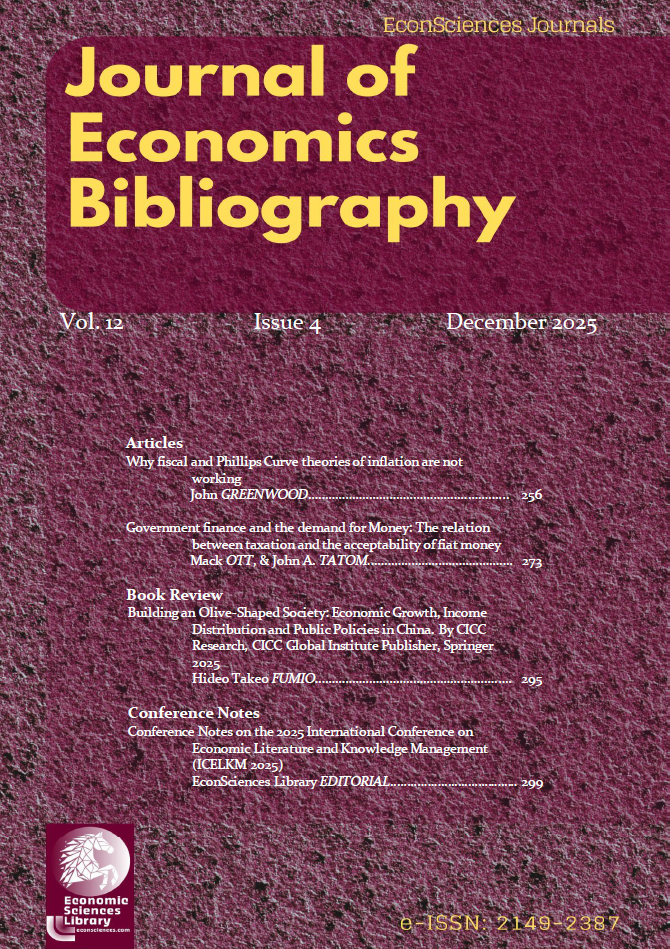
During the 2016-17 bull market in the US investors have been subjected to two main market scares – the possibility of near term inflation and the threat of an imminent recession, both spelling the end of the business cycle expansion. This paper examines first two commonly cited theories of inflation: the fiscal theory of the price level, and the Phillips curve (or output gap). Each is a form of reduced form analysis that omits any reference to the underlying monetary causes of inflation. I show that both in the US and more broadly across the OECD money and credit growth remain subdued. Since inflation is ultimately a monetary phenomenon, no sharp upswing in inflation can occur without a sustained period of faster money and credit growth. Second, the paper reviews briefly the basis for an extended business cycle expansion. The shape of the yield curve, money growth and the health of private sector balance sheets imply there is currently no basis for predicting an imminent recession. This justifies the view that the current expansion will continue for several more years with low inflation.
Keywords. Fiscal theory of the price level; Phillips curve; Inflation; Monetary growth.
JEL. E62; H54; O40.
References
Abramovitz, M. (1986). Catching up, forging ahead, and falling behind. Journal of Economic History, 46(2), 385-406. https://doi.org/10.1017/S0022050700046209
Achy, L. (2011). Tunisia’s Economic Challenges. The Carnegie Papers, December.
Afonso, A., Schuknecht L., & Tanzi, V. (2005). Public sector efficiency: An international comparison. Public Choice, 123(3-4), 321-347. https://doi.org/10.1007/s11127-005-7165-2
Agénor, P-R., & Montiel P. J. (1996). Development Macroeconomics. Princeton University Press.
Arrow, K. J. (1962). The economic implications of learning by doing. Review of Economic Studies, 29(3), 155-173. https://doi.org/10.2307/2295952
Arslan, Ü., & Sağlam, Y. (2011). The relationship between corruption and public investment: The case of Turkey. Sosyal Bilimler Enstitüsü Dergisi, 20(2), 365-378.
Aschauer, D. A. (1989). Is public expenditure productive? Journal of Monetary Economics, 23(2), 177-200. https://doi.org/10.1016/0304-3932(89)90047-0
Bardhan, P. (1997). Corruption and development: A review of issues. Journal of Economic Literature, 35(3), 1320-1346.
Barro, R. J. (1974). Are government bonds net wealth? Journal of Political Economy, 82(6), 1095-1117. https://doi.org/10.1086/260266
Barro, R. J. (1979). Second thoughts on Keynesian economics. American Economic Review, 69(2), 54-59.
Barro, R. J. (1990). Government spending in a simple model of endogenous growth. Journal of Political Economy, 98(5), 103-125. https://doi.org/10.1086/261726
Barro, R. J. (1997). Determinants of economic growth: A cross-country empirical study. MIT Press.
Berg, A., Buffie E. F., Pattillo C., Portillo R., Presbitero A., & Zanna L-F. (2015). Some misconceptions about public investment efficiency and growth (IMF Working Paper No. WP/15/272). International Monetary Fund.
Biehl, D. (1991). The role of infrastructure in regional policy. European Research in Regional Science, 1. London.
Blanchard, O. (1985). Debt, deficits, and finite horizons. Journal of Political Economy, 93(2), 223-247. https://doi.org/10.1086/261297
Blanchard, O., & Johnson D. R. (2013). Macroeconomics (6th ed.). Pearson Education.
Blanchard, O., & Perotti, R. (2002). An empirical characterization of the dynamic effects of changes in government spending and taxes on output. Quarterly Journal of Economics, 117(4), 1329-1368. https://doi.org/10.1162/003355302320935043
Boughzala, M., Chatta W., ElMarzougui E., & Zidi, F. (2007). Dépenses publiques, croissance et pauvreté régionales en Tunisie: Une microsimulation séquentielle (Poverty and Economic Policy (PEP) Report, May).
Buchanan, J. M. (1976). Barro on the Ricardian equivalence theorem. Journal of Political Economy, 84(2), 337-342. https://doi.org/10.1086/260436
Casero, P. A., & Varoudakis A. (2004). Growth, private investment, and the cost of doing business in Tunisia: A comparative perspective (World Bank working paper series, No: 34). World Bank.
Chow, G. (1993). Capital formation and economic growth in China. Quarterly Journal of Economics, 108(3), 809-842. https://doi.org/10.2307/2118409
Crafts, N. F. R. (2003). Is economic growth good for Us? World Economics, 4(3), 35-46.
Domar, E. D. (1946). Capital expansion, rate of growth and employment. Econometrica, 14(2), 137-147. https://doi.org/10.2307/1905364
Fagerberg, J. (1994). Technology and international differences in growth rates. Journal of Economic Literature, 32(3), 1147-1175.
Fosu, A. K., Getachew Y. Y., & Ziesemer T. (2011). Optimal public investment, growth, and consumption: Evidence from African countries (Working paper No 51). Maastricht Economic and social Research Institute on Innovation and Technology (UNU-MERIT).
Gali, J., Vallés J., & Lopez-Salido J. D. (2007). Understanding the effects of government spending on consumption. Journal of the European Economic Association, 5(1), 227-270. https://doi.org/10.1162/JEEA.2007.5.1.227
Ghani, E., & Din, M. (2006). The impact of public investment on economic growth in Pakistan. The Pakistan Development Review, 45(1), 87-98.
Giavazzi, F., & Pagano, M. (1990). Can severe fiscal contractions be expansionary? Tales of Two Small European Countries (NBER Macroeconomics Annual 1990). O. J. Blanchard & S. Fischer (Eds.). https://doi.org/10.3386/w3372
Gonand, F. (2007). The impact on growth of higher efficiency of public spending on schools (OECD Economic Department Working Paper No. 547). OECD Publishing. https://doi.org/10.1787/283634243573
Gupta, S., Kangur A., Papageorgiou, C., & Wane, A. (2014). Efficiency-adjusted public capital and growth. World Development, 57, 164–178. https://doi.org/10.1016/j.worlddev.2013.11.012
Hemming, R., Kell M., & Mahfouz, S. (2002). The effectiveness of fiscal policy in stimulating activity – A review of the literature (IMF Working Paper No. 02/208). International Monetary Fund.
Hirschmann, A. O. (1958). The strategy of economic development. Yale University Press.
International Monetary Fund (2014a). Tunisia: First and Second Reviews under the Stand-By Arrangement (IMF Country Report No. 14/50, February).
International Monetary Fund (2014b). Is it time for an infrastructure push? The macroeconomic effects of public investment. World Economic Outlook, October 2014: Legacies, Clouds, Uncertainties (Chapter 3, pp. 75-114).
Ismihan, M., Metin-Özcan K., & Tansel, A. (2002). Macroeconomic instability, capital accumulation and growth: The case of Turkey, 1963-1999 (Working Paper). Bilkent University.
Johansen, L. (1959). Substitution versus fixed production coefficients in the theory of economic growth: A synthesis. Econometrica, 27(2), 157-175. https://doi.org/10.2307/1909440
Kamps, C. (2004). The dynamic effects of public capital: VAR evidence for 22 OECD countries (Working Paper No. 1224). Kiel Institute.
Khan, M. S. (1996). Government investment and economic growth in the developing world. The Pakistan Development Review, 35(4), 419-439.
Kormendi, R. C., & Meguire, P. G. (1985). Macroeconomic determinants of growth. Journal of Monetary Economics, 32(3), 485-512. https://doi.org/10.1016/0304-3932(93)90027-D
Levacic, R., & Rebmann, A. (1982). An introduction to Keynesian-Neoclassical controversies (2nd ed.). ELBS/Macmillan.
Lucas, R. E. (1988). On the mechanics of economic development. Journal of Monetary Economics, 22(1), 3-42. https://doi.org/10.1016/0304-3932(88)90168-7
Mankiw, N. G. (1995). The growth of nations. Brookings Papers on Economic Activity.
Mankiw, N. G. (2010). Macroeconomics (7th ed.). Worth Publishers.
Mauro, P. (1996). The effects of corruption on growth, investment, and government expenditure (IMF Working Paper No. WP/96/98). International Monetary Fund.
Mauro, P. (2004). The persistence of corruption and slow economic growth. IMF Staff Papers, 51(1), 1-18.
Milbourne, R., Otto, G., & Voss, G. (2003). Public investment and economic growth. Applied Economics, 35(5), 527–540. https://doi.org/10.1080/0003684022000015883
Miller, N. J., & Tsoukis, C. (2001). On the optimality of public capital for long-run economic growth: Evidence from panel data. Applied Economics, 33(9), 1117-1129. https://doi.org/10.1080/00036840010003258
Mittnik, S., & Neumann, T. (2001). Dynamic effects of public investment: Vector autoregression evidence from six industrialized countries. Empirical Economics, 26(2), 429-446. https://doi.org/10.1007/s001810000064
Mountford, A., & Uhlig, H. (2004). What are the effects of fiscal policy shocks? (Working Paper). Humboldt University Berlin.
Nelson, R. R. (1964). Aggregate production functions and medium-range growth projections. The American Economic Review, 54(5), 575-606.
Parente, S. L., & Prescott, E. C. (1999). Monopoly rights: A barrier to riches. The American Economic Review, 89(5), 1216-1233. https://doi.org/10.1257/aer.89.5.1216
Perotti, R. (2004). Public investment: Another (different) look (IGIER Working Paper No 277).
Reynolds, L. G. (1985). Economic growth in the Third World, 1850–1980. Yale University Press.
Reynolds, L. G. (1994). Government and economic growth. G. M. Meier (Ed.), From classical economics to development economics. St Martin’s Press.
Rodrik, D. (2003). In search of prosperity: Analytic narratives on economic growth. Princeton University Press.
Romer, P. M. (1986). Increasing returns and long-run growth. Journal of Political Economy, 94(5), 1002-1037. https://doi.org/10.1086/261420
Romer, P. M. (1990). Endogenous technological change. Journal of Political Economy, 98(5), 71-102. https://doi.org/10.1086/261725
Romer, P. M. (1993). Idea gaps and object gaps in economic development. Journal of Monetary Economics, 32(3), 542-573. https://doi.org/10.1016/0304-3932(93)90029-F
Rosenberg, N., & Birdzell, L. E. (1986). How the West grew rich. Basic Books.
Rostow, W. W. (1960). The stages of economic growth. Cambridge University Press.
Sims, C. A. (1980). Comparisons of interwar and postwar business cycles: Monetarism reconsidered. American Economic Review, 70(2), 250-257.
Snowdon, B., & Vane, R. H. (2005). Macroeconomics: Its origins, development and current state. Edward Elgar Publishing Ltd.
Solow, R. M. (1956). A contribution to the theory of economic growth. Quarterly Journal of Economics, 70(1), 65-94. https://doi.org/10.2307/1884513
Stern, N. (1991). The determinants of growth. The Economic Journal, 101(404), 122-133. https://doi.org/10.2307/2233847
Sturm, J. E., & De Haan, J. (1995). Is public expenditure really productive? New evidence for the USA and the Netherlands. Economic Modeling, 12(1), 60-72. https://doi.org/10.1016/0264-9993(94)P4156-A
Swaby, R. (2007). Public investment and growth in Jamaica (Working Paper). Bank of Jamaica.
Swan, T. W. (1956). Economic growth and capital accumulation. Economic Record.
Temple, J. (1999). The new growth evidence. Journal of Economic Literature, 37(1), 112-156. https://doi.org/10.1257/jel.37.1.112
Trevithick, J. A. (1992). Involuntary unemployment: Macroeconomics from a Keynesian perspective. Harvester-Wheatsheaf.
UNCTAD (2009). Public investment: Vital for growth and renewal, but should it be a countercyclical weapon? (United Nations background report). United Nations.
Voss, G. (2002). Public and private investment in the United States and Canada. Economic Modelling, 19(4), 641-664. https://doi.org/10.1016/S0264-9993(00)00074-2
Warner, A. M. (2014). Public investment as an engine of growth (International Monetary Fund working paper no 14/148). International Monetary Fund.

This work is licensed under a Creative Commons Attribution-NonCommercial 4.0 International License.