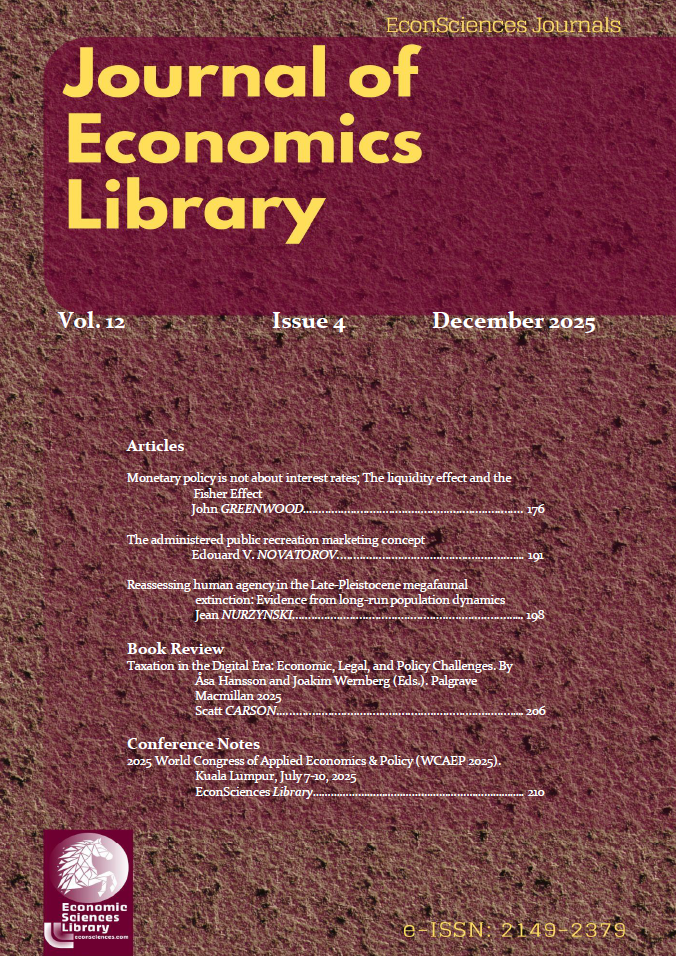
Abstract
The purpose of this paper is to clarify the relation between money and interest rates. Section 1 examines the empirical validity of Keynes’s claims for his liquidity preference theory by looking at the relation between changes in interest rates and changes in the quantity of money. Section 2 considers Irving Fisher’s findings. Fisher, whose studies had mostly preceded Keynes, had shown that over any longer-term horizon the relation between money and interest rates was exactly the reverse of Keynes’ hypothesis of short-term liquidity preference. A reconciliation is proposed that treats Keynes’ theory as a short-term, liquidity effect, and Fisher’s results, which incorporate the effect of inflation or inflation expectations, as the longer-term determinant of interest rates. Section 3 applies the resulting combined theory of the relation between money and interest rates to five case studies in recent decades: two from Japan, and one each from the Eurozone, the U.K. and the U.S. The conclusion is that interest rates are a highly misleading guide to the stance of monetary policy; it is invariably better to rely on the growth rate of a broad definition of money when assessing the stance of monetary policy.
Keywords. Unconventional Monetary Policy; Quantitative Easing; Fisher effetc.
JEL. E52, E58, G14.
References
Friedman, M. (1976, October 24). [Monetary policy is not about interest rates; monetary policy is about the rate of growth of the quantity of money.] [Interview]. Meet the Press. NBC. (Cited in EN, p. 349).
Keynes, J. M. (n.d.). The general theory.
Powell, J. (2018, August 24). Monetary policy in a changing economy [Speech]. Federal Reserve Board of Governors, Jackson Hole, WY.

This work is licensed under a Creative Commons Attribution-NonCommercial 4.0 International License.